Car Scam. From smooth talks to kidnapping: Kamran's narrow escape from a scam.
A man found a car listed far below market value on a classified ads website. He sold his own car, drove to meet the seller, and was kidnapped for ransom. This is how the trap works — and the two rules that could have saved him.
ONLINE SCAM
7/23/20265 min read
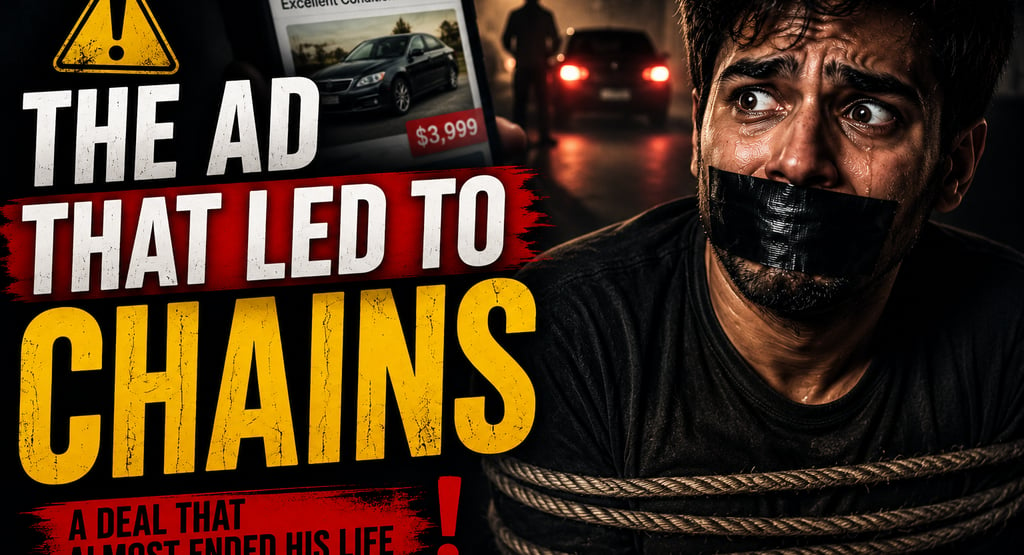
This story was submitted to our website. The name and details have been changed to protect the family involved. But every step of what you are about to read reflects a real pattern — one that has happened before, is happening now, and will happen again unless more people know what to look for.
Let consider the victims name was Kamran.
The Ad
Kamran was in the market for a car. Like most people today, he opened a classified ads website — the kind anyone uses, the kind that lists thousands of vehicles every day — and started browsing.
He found a listing that stopped him.
The car was exactly what he was looking for. Good condition. Clean photos. Complete description. And the price was not just competitive — it was unrealistically low. The kind of number that does not make sense for a vehicle in that condition.
It should have raised a question.
It raised excitement instead.
He contacted the seller. The reply came quickly. The conversation was easy — the seller was friendly, articulate, and had a ready explanation for the low price. A quick sale was needed. A family situation. Something that filled the gap between the price and reality just enough to feel believable.
They agreed to meet.
The Preparation
Before the meeting, Kamran sold his own car.
He did not want to risk losing the deal. The price was too good to wait. He needed the cash in hand, ready to move the moment he saw the vehicle in person.
He got the location from the seller. It was not a market. Not a petrol station. Not anywhere public or familiar. It was an address in an area he did not know well.
But the deal was waiting. So he went.
What Was Actually Waiting
When Kamran arrived, there was no car.
There were men.
They overpowered him. They tied him with ropes and chains. And then they contacted his family — with a ransom demand. A large sum of money, or Kamran does not come home.
The listing had never been real. The seller had never existed. The car, the photos, the price, the friendly conversation — all of it was engineered for one purpose: to get him to a place where he was alone, isolated, and vulnerable.
He had sold his car. He had driven himself there. He had walked in without telling anyone exactly where he was going.
The trap had worked perfectly.
The Outcome
Any trader with a large enough following becomes a target for this kind of offer. The larger the total value being traded across copy accounts, the more attractive the number becomes — for both the exchange and the trader.
The followers have no visibility into this. There is no alert, no notification, no opt-out window. From the moment you choose to copy someone, your positions are in their hands — and their exit is always available.
Yours may not be.
The One Rule That Protects You
Kamran was found by police and rescued. He came home.
He was lucky. And that word — lucky — is the part that should stay with you. Because luck is not a safety plan. Cases like this do not always end with a rescue. Some end with families paying everything they have and still losing someone. Some end in ways that are never fully recovered from.
The ad cost him nothing to find. The trap cost him almost everything.
How This Trap Is Set — And Why It Works
The mechanics are straightforward, which is part of why they are so effective.
A fake listing is posted on any classified ads platform — vehicles, property, electronics, anything high-value. The price is set noticeably below market value. Not so low it seems obviously fake, but low enough to create urgency. Low enough that the buyer feels they have found something rare and does not want to lose it.
The seller is always responsive. Always friendly. Always has an explanation. The conversation is designed to build just enough trust to get the buyer to a location.
The location is always chosen by the seller — somewhere unfamiliar to the buyer, somewhere with no witnesses, somewhere chosen specifically because it is not public.
By the time the buyer arrives, they have already done most of the work. They researched the listing. They arranged the money. They drove themselves there. They came alone.
The trap does not require force until the very last step.
Two Rules That Could Have Changed Everything
Neither of these rules is complicated. Both are easy to follow. And either one of them would have kept Kamran safe.
Rule One: If the price is unrealistically good — it is not a deal. It is bait.
Before you contact any seller, ask yourself one honest question: why would a stranger sell something worth this much for this little, to someone they found online?
There is almost never a good answer. A genuine seller with a genuine reason for a lower price will still be within a reasonable range of market value. When the price is so far below what makes sense that it catches your attention immediately — that gap is not an opportunity. It is a hook.
Walk away.
Rule Two: Never go to their location. Always meet in public — a place you choose.
This is non-negotiable for any classified ads transaction.
Choose a busy petrol station, a commercial market, a bank, anywhere with people constantly around and cameras present. Tell someone where you are going and who you are meeting before you leave. Share the seller's number with a trusted person.
If the seller refuses to meet somewhere public — that refusal is your answer. No legitimate seller has a reason to avoid a public meeting point.
Your safety is worth more than any vehicle, any deal, any price.
This Happens More Than You Know
Classified ads platforms are not inherently dangerous. Millions of safe, legitimate transactions happen on them every day. But the same features that make them useful — easy listings, anonymous contact, no verification — also make them attractive to people who use listings as traps.
This is not limited to vehicles. It happens with property viewings, electronics sales, job offers, and rental listings. The item changes. The structure of the trap stays the same.
A price designed to create urgency. A conversation designed to create trust. A location designed to create vulnerability.
The best protection is knowing what to look for before you ever make contact.
Disclaimer
The story shared in this post is based on someone experience. To protect the privacy and identity of those involved, names and identifying details have been changed, and any visuals or characters used alongside this story in video form are AI-generated and do not depict any real person.
This content is created strictly for educational and awareness purposes, to help readers recognize common scam tactics and protect themselves. This is not financial, legal, or banking advice. For any concerns about your account or transactions, always contact your bank directly through official, verified channels.
Viewer discretion advised. Awareness is your first protection.
He Sold His Car to Buy a Better One. The Seller Was Waiting With Ropes and Chains.
Real Scam Stories
Whether you were scammed or narrowly escaped a scam, your story could be the warning that saves someone else.
Join Our Community
Subscribe to our YouTube channel for in-depth video investigations, real scam stories, and expert prevention tips. Stay informed and help us protect others.
THE HIDDEN TRAP
Raising awareness through real scam stories. Help others avoid falling into the same trap.
Quick Links
© 2026. All rights reserved by THE HIDDEN TRAP.
your well wisher.