I Almost sent $5,000 to a Bank Scammer
A true story about how a single phone call nearly wiped out my neighbor's savings, and the exact moment everything fell apart for the scammer behind it.
BANKING FRAUD
6/21/20266 min read
It Started as a Normal Afternoon
I was sitting outside my shop on an ordinary day. My phone was connected to the WiFi. Nothing about that afternoon suggested anything was about to go wrong.
Then my neighbor walked up to me, and I could tell from her face that something was off.
"Someone just called me," she said. "He told me he's from the bank. He said five thousand dollars was removed from my account by someone else. He wants me to check it and call him back."
My first reaction was immediate: this sounded like a scam. Banks don't usually call you out of nowhere and ask you to confirm your balance over the phone. I told her that. I told her this wasn't how banks normally operate.
But she was scared. She asked me to just check, one time, to be sure.
I couldn't say no to that. I asked her to sit down, took her phone, connected to the WiFi, and opened her banking app.
Before the screen even finished loading, the same number called again.
The Moment the Story Became "Real"
I picked up and told the caller to wait a second. I opened the app.
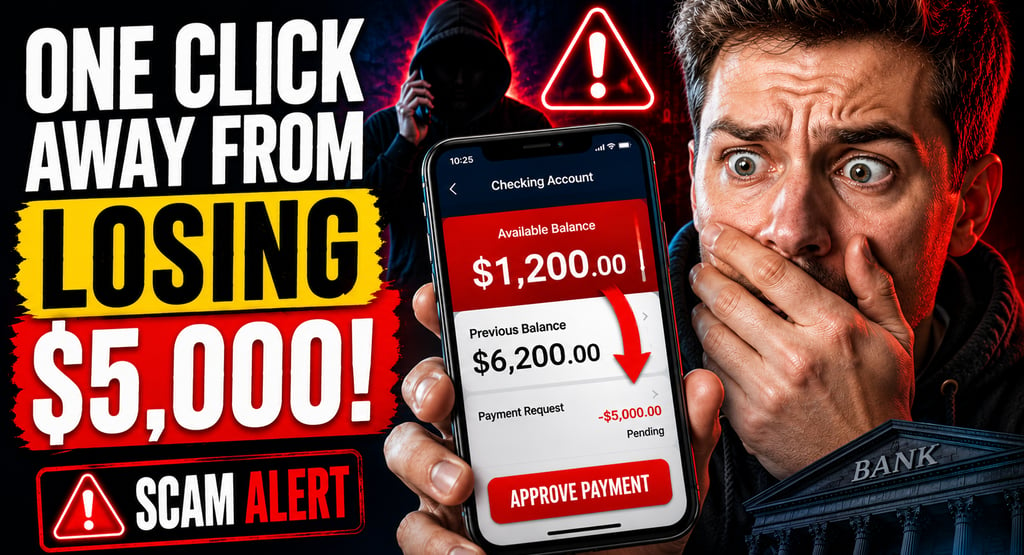
The balance read $1,200. It should have read $6,200.
Five thousand dollars — missing. The exact number the caller had mentioned.
In that moment, every bit of doubt I had disappeared. The proof was right there on the screen. This man wasn't lying. Something really had happened to that account.
Or at least, that's what it looked like.
A "Professional" on the Other End
When I called him back, I noticed how calm and composed he sounded. Patient. Confident. The kind of voice that makes you trust someone instantly, the way you'd trust an actual bank representative.
He walked me through the app, step by step, until we landed on a payment request screen. There it was — a request for exactly $5,000.
"This is why your balance is showing less," he explained. "Someone sent this request. Just cancel it, and your money will come back."
I cancelled it. And right in front of me, the balance jumped back to $6,200.
The Moment Everything Became Clear
That single moment — watching the balance bounce back the instant I cancelled the request — is when I understood exactly what was happening.
Think about it logically. If cancelling a pending request restored the balance, that meant the money had never actually been stolen in the first place. There was no theft. There was no crime that had already happened.
What this man had done was simple, and disturbingly clever: he had sent the payment request to my neighbor's account himself, routed through an online buy-and-sell website so it wouldn't look suspicious. Then he called, claimed money had been stolen, and guided us straight to that same request on the screen — presenting it as proof of a crime he had staged himself.
He wasn't a bank employee trying to help us. He was the one trying to take the money.
And now I knew exactly what was coming next. He'd call back. He'd send another request. And this time, he wouldn't ask us to cancel it — he'd ask us to approve it.
So I made a decision. I was going to play along.
The Real Attack
A few minutes later, he called again, right on schedule.
This time he asked something different: "Do you have ten thousand dollars in the account?"
I said no. Looking back, that question told me everything — he wasn't just stealing. He was measuring exactly how much he could take.
He sent another request. Five thousand dollars, again. But this time his instructions changed.
"You need to secure your amount," he said. "Follow exactly what I tell you. I will protect your money."
Secure. A small word carrying a very big lie.
I didn't actually follow his instructions. I pretended to.
I told him yes, I was doing it. Yes, I had pressed it. Yes, I had entered everything he asked for.
Then I said, calmly: "Okay... the balance is now showing $1,200. The five thousand dollars is gone."
When the Mask Came Off
The calm, professional voice disappeared instantly.
"Why are you lying?" he snapped. "I am from the bank. Why are you wasting my time? Just follow the prompts right now and your money will be safe."
He was angry. Frustrated. His script wasn't working anymore, and he could feel it slipping.
That's when I knew I had him.
"Before I do anything else," I said, "tell me your name. And give me your CNIC number."
Silence.
Then the call cut. He blocked the number. Just like that — gone. No goodbye, no further explanation. The calm, helpful "bank officer" who was supposedly protecting our money vanished the second I asked who he actually was.
What Stayed With Me After
I sat there thinking about how many other people this same man had probably called that very same day.
And then I thought about my neighbor. She came to me because she was scared and needed help. If she had handled that call completely alone — without someone sitting next to her who understood what was happening — she could have lost everything. Every saving she had. Gone, in under ten minutes.
That thought stuck with me.
Because not everyone has someone to turn to in that moment. Not everyone understands how payment requests work inside banking apps. Not everyone knows what a "pending request" even is. And scammers like this one know that — they're counting on exactly that gap in knowledge.
That's why I'm sharing this story. Not because I'm an expert in banking or cybersecurity, but because I was there. I watched it happen in real time, and I know exactly how convincing it looks from the inside.
If there's one thing I want you to take from this story, it's this: whenever something feels off with a call about your money, don't handle it alone. Talk to someone you trust first — a family member, a friend, anyone. That one step is what saved my neighbor's savings that day.
How This Scam Actually Worked
Understanding the mechanics behind this scam is the best protection against it.
Why did he use a payment request instead of asking for a direct transfer?
A direct transfer would have gone straight into his own bank account — traceable, with his name attached, easy for police to track down. But a payment request sent through an online buy-and-sell website looks like an ordinary online purchase. Not a scam. Not a theft. Just someone buying something online. It's far harder to trace and far harder to reverse.
This wasn't a lucky guess on his part. It was a system, built specifically to look legitimate while staying hard to trace.
How You Can Protect Yourself From This Exact Scam
Hang up and call your bank yourself. If anyone calls claiming to be from your bank, end the call and dial the number on your bank card or inside your official app directly. Never call back the number that called you.
Watch for pressure and urgency. If someone is calling you back again and again, refusing to give you time to think, that isn't urgency — that's a tactic. A real bank will always give you time to verify.
No bank will ever ask you to "approve" a request to protect your money. If someone tells you to "secure your amount" by following their instructions on a payment app, stop immediately. That phrase alone is a major red flag.
Be cautious of any step that seems to "fix" the problem too easily. A scammer may walk you through a small, reversible action first to build your trust before asking for the real one.
Never share your PIN, OTP, or any code sent to your phone with anyone who called you first — no matter how calm or official they sound. The smoother the voice, the more caution you should use.
Final Thoughts
This wasn't a story about carelessness. It was a story about how convincingly fear can be manufactured over a phone call, and how a single staged "proof" on a screen can override every instinct telling you to slow down.
No hacking happened here. No malware. Just a phone call, a few taps on a screen, and the very human instinct to help someone you care about when they're scared.
That's exactly what makes this kind of scam so dangerous — and so important to understand. It doesn't target careless people. It targets caring ones.
If you've ever been scammed — or narrowly escaped one — share your story with us at The Hidden Trap. Your experience could become the warning that protects someone else from falling into the same trap.
Disclaimer
The story shared in this post is based on a real personal experience. To protect the privacy and identity of those involved, names and identifying details have been changed, and any visuals or characters used alongside this story in video form are AI-generated and do not depict any real person.
This content is created strictly for educational and awareness purposes, to help readers recognize common scam tactics and protect themselves. This is not financial, legal, or banking advice. For any concerns about your account or transactions, always contact your bank directly through official, verified channels.
Viewer discretion advised. Awareness is your first protection.
Real Scam Stories
Whether you were scammed or narrowly escaped a scam, your story could be the warning that saves someone else.
Join Our Community
Subscribe to our YouTube channel for in-depth video investigations, real scam stories, and expert prevention tips. Stay informed and help us protect others.
THE HIDDEN TRAP
Raising awareness through real scam stories. Help others avoid falling into the same trap.
Quick Links
© 2026. All rights reserved by THE HIDDEN TRAP.
your well wisher.